How AI Is Reshaping the Software Development Life Cycle
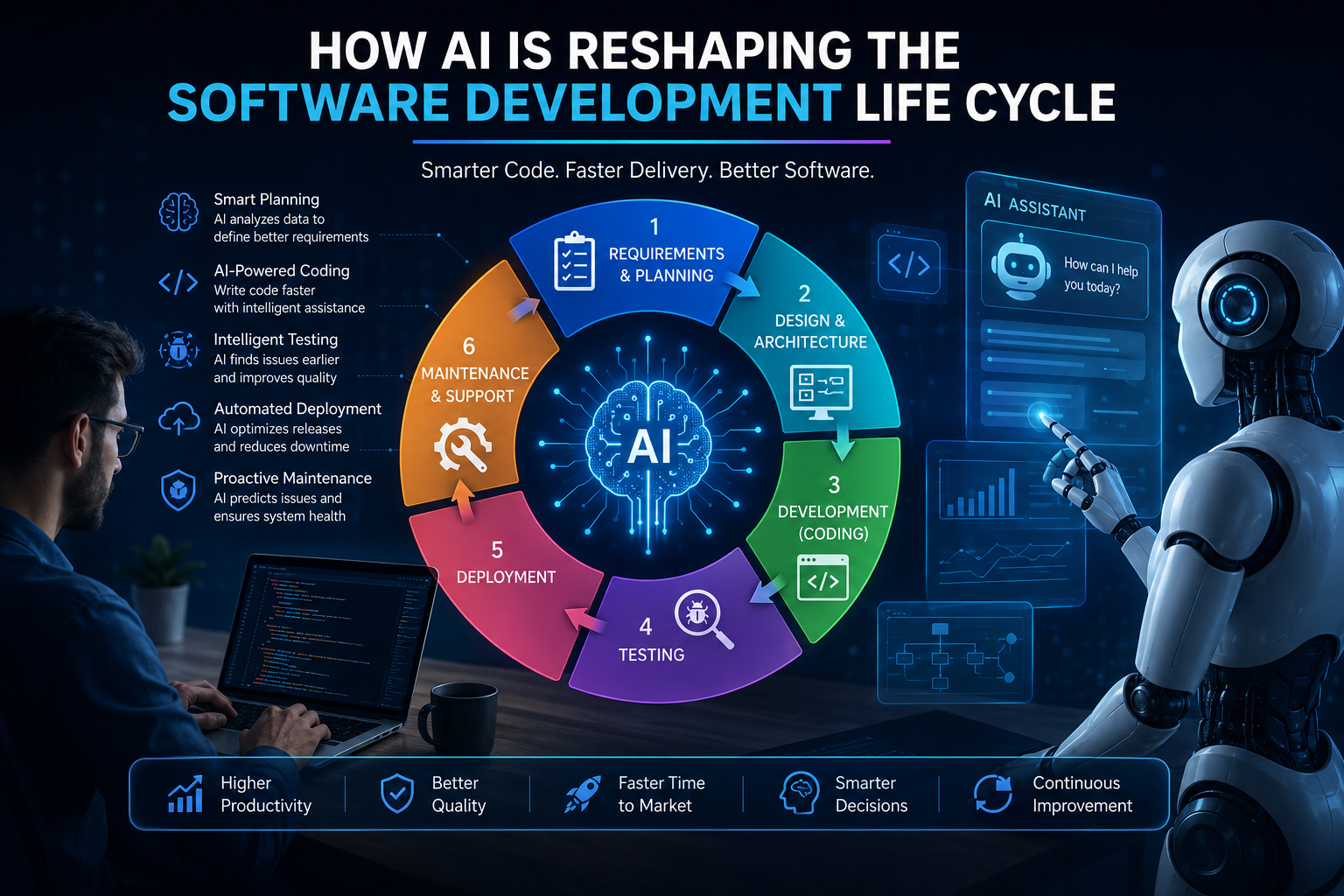
Software development has never stood still. From waterfall to agile, from manual deployments to DevOps automation, the industry has continuously evolved to deliver software faster and more efficiently. Now, Artificial Intelligence is driving the next major transformation one that is changing how software is planned, designed, developed, tested, deployed, and maintained.
AI is no longer just a feature inside applications. It has become an active participant in the software development life cycle (SDLC) itself. Development teams are using AI-powered tools to reduce repetitive work, improve accuracy, accelerate delivery timelines, and make smarter engineering decisions.
But despite all the excitement around AI, the real story is not about replacing developers. It is about changing the nature of software engineering and allowing teams to focus more on creativity, architecture, and problem-solving rather than routine tasks.
The Traditional SDLC Is Changing
The traditional software development life cycle typically includes several stages:
- Requirement gathering
- PlanningDesign
- Development
- Testing
- Deployment
- Maintenance
AI is now influencing every single one of these phases.
What once required days of manual effort can now be completed in hours with the support of intelligent systems. Teams are becoming more productive, projects are moving faster, and businesses are able to respond to market demands more quickly than ever before.
However, this transformation also brings new challenges related to security, ethics, reliability, and workforce adaptation.
AI in Requirement Gathering and Planning
One of the earliest stages of any software project is understanding business requirements. Traditionally, this process involved long meetings, documentation reviews, stakeholder interviews, and manual analysis.
AI tools are now helping organizations analyze customer feedback, support tickets, user behavior, and business data to identify patterns and generate insights automatically. Natural Language Processing (NLP) systems can summarize discussions, extract requirements from documents, and even suggest project scopes based on previous implementations.
Project managers are also using AI-powered forecasting tools to estimate timelines, identify project risks, and allocate resources more effectively.
This reduces uncertainty during the planning phase and improves decision-making from the start of the project.
Smarter Design and Architecture
Software architecture has always depended heavily on human experience and technical expertise. While that remains true, AI is beginning to assist architects and engineers by recommending design patterns, identifying scalability concerns, and suggesting optimized system structures.
Modern AI systems can analyze existing architectures and compare them with industry best practices. They can detect bottlenecks before development even begins and help teams avoid costly redesigns later in the project.
UI/UX design is also evolving rapidly with AI. Designers now use AI-assisted platforms to generate layouts, prototypes, color schemes, accessibility recommendations, and even responsive design suggestions within minutes.
Instead of replacing creativity, AI acts as an accelerator that helps teams explore more ideas in less time.
AI-Powered Coding Is Accelerating Development
Perhaps the most visible impact of AI is happening during the coding phase.
AI coding assistants can now generate functions, recommend code snippets, explain logic, identify bugs, and autocomplete large sections of code. Developers are spending less time writing repetitive boilerplate code and more time solving actual business problems.
This shift is significantly increasing developer productivity.
Junior developers benefit from faster learning and guidance, while experienced engineers can prototype applications much more quickly. Teams are also able to maintain better consistency across projects because AI tools can enforce coding standards automatically.
However, AI-generated code still requires human oversight. Developers must validate logic, security, scalability, and maintainability before production deployment.
The best results come when human expertise and AI capabilities work together.
Software Testing Is Becoming More Intelligent
Testing has traditionally been one of the most time-consuming phases of software development. Writing test cases, executing regression testing, identifying edge cases, and debugging issues often consumed a large portion of project timelines.
AI is transforming this process dramatically.
AI-powered testing platforms can now:
- Generate automated test cases
- Predict high-risk areas in applications
- Detect anomalies in system behavior
- Perform visual UI testing
- Reduce repetitive regression testing
- Identify performance bottlenecks earlier
Machine learning models can analyze previous defects and predict where future failures are most likely to occur. This allows QA teams to focus their efforts more strategically.
The result is faster release cycles, improved software quality, and reduced operational costs.
DevOps and Deployment Automation
AI is also playing a growing role in DevOps practices.
Modern deployment pipelines increasingly use AI to monitor infrastructure, optimize resource allocation, predict system failures, and automate incident response processes.
Instead of waiting for systems to fail, AI-driven monitoring tools can identify unusual patterns and alert teams before downtime occurs. Some platforms can even initiate automated recovery actions without human intervention.
This predictive capability improves system reliability and reduces operational disruption.
Cloud environments especially benefit from AI-driven optimization because infrastructure demands change constantly. AI systems can scale resources dynamically based on real-time usage patterns, helping organizations reduce unnecessary costs.
AI in Cybersecurity and Maintenance
Software maintenance does not end after deployment. Applications require continuous monitoring, updates, bug fixes, and security management.
AI is becoming essential in cybersecurity operations by detecting suspicious activities, identifying vulnerabilities, and responding to threats faster than manual systems.
Security teams now rely on AI to analyze massive volumes of logs and network activity that would be impossible for humans to review efficiently.
AI can also help maintain legacy systems by analyzing old codebases, identifying technical debt, and recommending modernization strategies.
For businesses managing complex software ecosystems, this capability is becoming increasingly valuable.
The Human Side of AI in Development
Despite rapid advancements, AI is not eliminating the need for software engineers.
In fact, human expertise is becoming even more important.
AI tools can generate outputs quickly, but they still lack true business understanding, contextual reasoning, ethical judgment, and strategic thinking. Human developers remain responsible for architecture decisions, quality assurance, innovation, stakeholder communication, and aligning technology with business goals.
The role of developers is evolving rather than disappearing.
Engineers are moving away from repetitive implementation work and toward higher-value responsibilities such as:
- System design
- AI supervision
- Product strategy
- Security governance
- User experience optimization
- Innovation and experimentation
Organizations that understand this balance will gain the greatest advantage from AI adoption.
Challenges Businesses Must Consider
While AI brings enormous opportunities, companies must also address several challenges:
Code Reliability
AI-generated code is not always accurate or optimized. Poor validation can introduce bugs or security risks.
Security and Privacy
AI tools often interact with sensitive source code and company data. Organizations must ensure proper security controls and compliance standards.
Skill Gaps
Teams need new skills to effectively work with AI systems. Continuous learning is becoming essential in modern software engineering.
Ethical Concerns
Bias, transparency, intellectual property issues, and accountability remain major concerns in AI-assisted development.
Overdependence on Automation
Relying too heavily on AI without human review can create long-term technical debt and operational risks.
Successful organizations are approaching AI adoption strategically rather than blindly automating everything.
The Future of Software Development
The future of software development will likely be defined by collaboration between humans and intelligent systems.
AI will continue automating repetitive tasks, improving productivity, and accelerating innovation. Development teams will become smaller, faster, and more efficient, but human creativity and engineering judgment will remain irreplaceable.
Companies that embrace AI thoughtfully will gain significant competitive advantages in speed, scalability, and product quality.
At the same time, businesses that ignore AI’s impact on the SDLC risk falling behind in an industry that is evolving faster than ever before.
The software development life cycle is no longer just about writing code. It is becoming an intelligent, data-driven ecosystem where AI enhances every stage of the process.
And this transformation is only getting started.
